

| About Us | Contact Us | Member Database | Contact Database | Support Us |


 Nuclear
Energy
Nuclear
Energy Gender
 Structural
Funds
Structural
Funds| School Resources Home | Games | Experiments | Teaching Material | Projects | Programs | Links |
website |
description |
 Save the Earth, (Red Jorden) Save the Earth, (Red Jorden)Organisation: Climate Caravan (Klimakaravanen) of organisations like Danmarks Naturfredningsforening, Friluftsrådet/Grønt Flag Grøn Skole, Skole Energi Forum, Elmuseet and many others. Link: www.vekbh.dk/klimakaravanen/ CO2 Calculator and many other material: See English Review and material Age group: 8.-9. class 14-15 years old |
|
 The
Danish School Energy Forum developed
links in 2007-2010, which are not available anymore. The
Danish School Energy Forum developed
links in 2007-2010, which are not available anymore.Courses are available from here: energitjenesten.dk/kontakt-energitjenestens-skoleindsats.html Contact: Danish School Energy Forum, and Skolernes Energi Forum are not existing any more. For more information on the activities OVE/VE/Energitjenesten can be contacted (OVE The Danish Organisation for Renewable Energy, VedvarendeEnergi (VE) - INFORSE member. Address: Klosterport 4F, 8000 Aarhus C, Denmark. E-mail : bs@energitjenesten.dk, Ph: +45 86760744 / 36 98 68 26 |
|
| Games, where links are not available anymore: | |
|
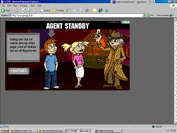
Description: This
is an animated game where you have to switch off all electric machines
that are in standby mode. It has
been made to make
children more aware of the standby problematic. |
|
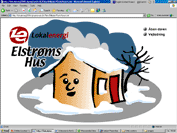
Description: This is a program, where you can go into different rooms of a house. There is a chart where you can put in how many types of equipment you have in your house and how much do you use them. The chart calculate how much does it cost for you to use energy by using different machines. You can calculate how much electricity you use each year by telling how often you use the TV for example. Another aspect of the program is that you can calculate how much you can save by decreasing your use by switching off the standby buttons. It is made by the Galten Electricity power plant. |
|
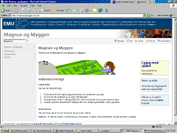
Description: “Magnus and the Moscito Environment” (Magnus og Myggen) packman like game, where you have to gather phones or computers. 12-13 years child (5th-6th class) with guide for the teachers. |
|
Description: This is a program,
where you follow two children in Uganda who are looking at different
problems like energy, water,
forest
and trash from different angles. |
| The Contract on Energy
as a Game, (Kontrakten: Energien på Spil) Link: www.kontrakten.net (not available anymore) Organisations: Learning Lab Denmark (DPU), Skolernes EnergiForum, Esbensen Rådgivende Ingeniører A/S for Dansk Energi. Age Group: 8.-10. class 13 -16 years old Development year: 2006-07 |
Description: The class should be divided
op to 4 groups, and the best group wins. |
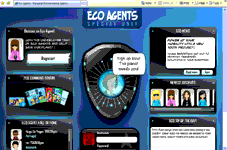 Become Eco-Agent, and
Help Protect the Environment (Bliv EcoAgent) Become Eco-Agent, and
Help Protect the Environment (Bliv EcoAgent)Organisation: EEA Link: ecoagents.eea.europa.eu (not available anymore) Read: English review, Download material. |
Description at Games/Europe. Available in 26 European languages (including Danish) |
|
Description at Games/Europe. Available in 21 European languages (including Danish) |
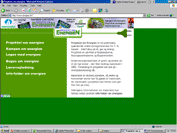 Project
Energy (Projekt Energien) Project
Energy (Projekt Energien)Link: www.energien.dk (not available anymore) Organization: Association of the Danish Electricity Distributors (ELFOR). Topic: Energy Saving Age group: It is for 7th-8th class (13-15 year). Description: "Battle for Energy” is a strategy game in the “Simcity” style, where you have to make a city that can provide itself with energy and other resources. During the time you learn about the history of energy and its meaning to the society. You are a major and the workers are coming to the town to build the city. Resources are: wood, food and bricks. Houses, universities, hospitals, factories, farms have to be built, which all needs energy. During the game, different technologies like electricity and machines are discovered. Natural gas is substituting coal and oil. Different energy forms have influence on the environment and energy efficient measures are needed. - Interactive experiments where you can try to put together a transformer, a dynamo, etc. - A book, which holds lot of information about all kinds of electricity, where we use it, how we use it and when we use it. - A Teacher Guide to all material - Description of a Role Play connected to the “Battle for Energy”. Roles are: major, priest, journalists, company owners, etc. There are 4 modules: 1.0 1880 - Steam machines substituted by electricity (1890). More electricity is needed. Where should they be built. 2.0 1955 - Which city should have the new effective electricity plant? Which city has the best energy policy? Marshall Help. 3.0 1975 - Oil crisis. New energy forms and energy efficiency is needed. Each city should make an energy information campaign and should present it to the Energy Council. The Minister is the teacher. 4.0 2002- Resources do not keep forever. New energy sources are needed. All cities needs energy but with minimal environmental pollution. Each city comes with 2 proposals for new energy sources to a general meeting, where they should be discussed. |
|
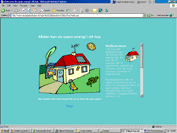 The
The Active House (Det dynamiske hus) The
The Active House (Det dynamiske hus) Organization: National Danish Energy Information Centre Link: Closed Topic: Energy Saving Age group: 12-16 year old |
Description: This program
tells you how much power your house use by telling you, where you can
save some electricity and where you lose most energy. You can go into
the house and point on different machines and part of the House and read
about the energy use and energy saving possibility. It links to several other Danish sites to get more information on energy saving. Information to general public by the National Danish Energy Information Centre (1999-2003) on behalf of the Danish Energy Authority. |
|
Description: It is organised
in different age groups (classes 4-5, 6-7, 8-9), experiments, games,
etc. There are experiments where you work with subjects such as solar energy, wind energy, etc. There are 4 interactive games: - Kitchen: You can try to cook potatoes or do other things in a kitchen such as learn about how to save energy in the kitchen. You need to click on different things (pot, top of the pot etc ) to cook. - Electricity-simulator: You can try to be the energy minister for 10 years - Standby test - Where the electricity come from |
Energy
Minister Game (Elministerspil) |
Description: Interaktive computer game. As Danish energy minister, you need to provide light and heat to all. You can choose among different technical solutions, and different types of energy sources. In the same time you need to care about the environment and the CO2 emissions. You realise that it is not easy to make everybody satisfied. |
 Environmental
Educational Page,
Environmental
Educational Page,  Nature
Culture Educational Material, Naturkultur - et undervisningsmateriale
Nature
Culture Educational Material, Naturkultur - et undervisningsmateriale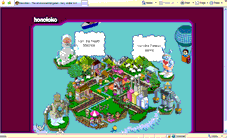 Honoloko: An
Island
to Learn How to Care for Health and the Environment
Honoloko: An
Island
to Learn How to Care for Health and the Environment