INFORSE-Europe logo

Search on the site:
 
  
EnglishSpanish French Hungarian Slovak Polish German
 
About Us Contact Us Member Database Contact Database Support Us
PortugueseRomanian Turkish Bulgarian Macedonian Russian Danish
ACTIVITIES
  100% Renewables
Seminars & Events
  Projects
  LCS Network
PUBLICATIONS
  Press Releases
  Newsletter
  Reports
POLICY
United Nations
European Union
  Nuclear Energy
  Gender
  Structural Funds
EDUCATION


School Resources
  DIERET
  Study tours 
  Success Stories 
  Test yourself Quiz
  Useful Links
VISIT INFORSE.ORG

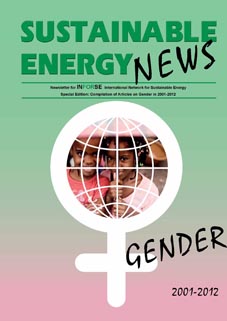
Gender Theme - Sustainable Energy News
See also 2012 Publication: Gender Reader


Articles of the Gender, Climate & Energy
Published in Sustainable Energy News:

Theme: Women
Women at UNFCCC & 40 % Women in Boards
Issue #74, November 2012, (pp. 10-11)

Articles:
- Women at
UNFCCC COP18
- 40 % women in Boards in EU by 2020?
- Women Position Paper to The World We Want - Post 2015

Publications in 2012:
- UNDP Report: Powerful Synergies
- EIGE Report: Gender and Climate Change in EU 27


Theme: Women
Rio+20 - from Women's Perspective
Issue #73, June 2012, (pp. 6-7)

Women as a Major Group” to the Rio+20 Process has submitted a position statement, which represents the positions of over 70 women's organisations. It was compiled by a steering committee including the two INFORSE members, WECF and ENERGIA.

This article features some parts of the position that are especially relevant to the promotion of sustainable energy.

Key Problems highlighted:
- 2.4 billion people in developing countries still depend almost entirely on traditional biomass fuels (wood, charcoal, dung and agricultural residues). It is mostly women who are tasked with collecting and managing these fuels. Cooking indoors, without chimney, causes widespread respiratory diseases.
- 70 % of the 1.3 billion people living on less than one dollar per day are women. The situation is worsening due to current food and fuel crises caused by climate changes (flooding, draught), and financial crises.
- Women are more affected by the adverse impacts of nuclear radiation, and climate change than men.
- Unsustainable energy use (nuclear, fossils, and coal) is threat for our generation and to that of our children. This is demonstrated by effects of nuclear disasters, climate changes, and environmental pollution.
- Women are deeply underrepresented in decision making bodies all over the world. Without true representation of their needs, women are left without a voice.

Women call for that the Governments Agree:
- to make a decisive position to immediate phase out of nuclear energy and take the path to promote the use of renewable energy.
- to create incentives and a fair legal environment for renewable energy, and for women’s access to these resources.
- to invest in access to clean sustainable renewable energy sources and energy efficient technology.
- to stop direct and indirect subsidies to unsustainable energy supplies (nuclear, shale gas, tar sands, and coal) currently estimated at 7-9 billion Euro annually.
- to commit a legally binding mechanism to address the cost of decommissioning and clean up of nuclear power plants, nuclear waste and uranium mines, to be paid by the nuclear industry.
- to make gender equality as a pillar of governance including the further promotion of the Rio Principle 20 towards the full participation of women. This can be done by quotas or time-bound targets of minimum participation of women e. g., 40%. Supportive tools can include: changing governance cultures, capacity building, gender sensitive indicators, spreading technologies that free women’s time, supporting anti discrimination labour laws, and ensuring equal pay.
- to reform the fiscal system internalising external costs
- to going beyond GDP with new economic indicators which take women’s contributions and natural capital into account.
- to reallocate military funds to sustainable development.


Download the articles Gender-SEN 73 (pdf, pp. 6-7, 0.5 MB) or the full issue at Sustainable Energy News.

Women rio+20You can also
read the full Position under "Major Groups", "Women" at: www.uncsd2012.org, as well as sign a summary of it at www.womenrio20.org


Theme: Women, Climate & Energy
Issue #68
March-April 2010
(pages 7-11.)
- Women Say: “Don’t Nuke the Climate”
- Gender Justice at COP15: Half of Nothing is Nothing
- Gender, Cities and Climate Change
- Climate at UN Status of Women Conference, NGO committee
- Community Radio Spreading
- Publications
- Events

Download the articles: Gender-SEN # 68, (pp. 7-11
930 kB)


Theme: Women, Climate & Energy
Issue #65
July 2009
(page 2. editorial and pages 7-11.)

( 6-page Women Theme 2.51 MB pdf)

Contents:

Editorial: Women in Focus by Judit Szoleczky, INFORSE-Europe
Women in Bonn’09
- Lobby for the Integration of Gender into the Copenhagen Outcomes
- “Don’t Nuke the Climate” Action, & Side Event, Bonn, June, 2009
WECF to Change CDM rules
50-50 Campaign for Democracy
Swedish EU Presidency: Full Speed on Gender Equality
Road to Copenhagen Forum via Wiki
Environmental Polls in Estonia
Create a UN Women’s Agency Now!
Prize of US$ 1.5 Million, Bangladesh
Publications::
- Brussels Women’s Energy Club
- Gender and Climate Finance: Double Mainstreaming for Sustainable Development by Heinrich Böll Foundation
- Resource Guide on Gender and Climate Change by UNDP.
- Training Manual on Gender and Climate Change by GGCA, (IUCN, UNDP, WEDO, UNESCO, FAO, ENERGIA.)
- Report: Small-Scale Bioenergy Initiatives by PISCES
- Biofuels for Sustainable Rural Development and Empowerment of Women, by ENERGIA
- Gender and Equity in Bioenergy Access and Delivery in Kenya, PISCES


Issue #60, April 2008 (p.2-9) (8-page 1MB pdf file)
Theme: Women - Energy - Climate


Editorial:

Gender Editorial: More Women Needed for Decisions,
Break the “Glass Ceiling” on Sustainability

Seeking Global Influences:
Don’t nuke the climate“ Women Actions in Bali
Women’s Role in the UN Climate Process: from Berlin to Bali and Beyond
No Climate Justice without Gender Justice, Women activities in February, 2008 in Monaco


Local and Regional Efforts:

Kyrgystan: Women’s Grass-Root Participation Brings Changes
Bangladesh: 1000 Women Trained to Solar and Cookstoves
Asia: CRT-Nepal Became Asia Coordinator for ENERGIA
India: Follow-up of INFORSE Activities:
Manuals, Jatropha, Open Uni,
Soft Loans, Financing
India: Micro-hydro Units in the Himalayas

Who is Who?

Issue #59, December 2007 (p. 3, p. 8, p. 9)
Short news and picture from the Press Briefing of the Gender and Climate Change Network - Women for Climate Justice (GenderCC),
Ulrike Roehr (representing INFORSE member organisation Life e.V.) acting as coordinator for the new Network GenderCC. (p. 3)
More details on women actions in issue #60.

See more on the UN event in Bali: UN CSD15
, as well as the UNFCCC's side event list, where you can download the presentations of the side event organised by LIFE e.V. and GenderCC, Thursday, 6 December 2007 (10.30-12.30).

A Great "No-smoke" - Kitchen in Sri Lanka (p. 9)
By Zareen Myles, Women's Action For Development (WAFD), INFORSE member, India
Seminars & Manual to Sustainable Energy for Poverty Reduction (p. 8)

By Raymond Myles, INFORSE South Asia Coordinator INSEDA, India.
Training Manuals for Sustainable Energy Solutions to Reduce Poverty. Available in English, Bangladeshi, Hindi, Nepalese and Singhalese. The Manual is a result of a 3-year cooperation project among INFORSE organisations. Read more on the manual at: INFORSE-Asia

Issue #56, April 2007(p.3)
CSD 15: Challenge for Sustainable Energy

Side Events at IPM & CSD, February and April, 2007
Among the INFORSE organisations who made presentations: CRT, Nepal which is also ENERGIA Asia Coordinator; Grameen Shakti, which provides micro-credit to women in Bangladesh to install solar energy.
Read about this side event and about other INFORSE members' side events like ENERGIA at UN CSD 15 and IPM to CSD15.

Issue #55, December 2006

Regional Reports on Women and Energy (p.10)
ENERGIA's input to UN CSD-15. (ENERGIA is member of INFORSE)

Issue #54, September 2006
Collecting Information for a Study on Gender and Climate 2006-07
(p.11)
By Ulrike Roehr and Minu Hemmati, genanet / LIFE e.V., INFORSE member organisation

Issue #53, June 2006
UN CSD-14 Side-Event: Women
- Nuclear Energy is Not the Solution (p.3)

Issue #51, December 2005
World & Gender
(p. 9-10)
Montreal Marked a "New Era" for Gender and Climate 51 kB file (2 pages)

Issue #50, September 2005
Gender Equality & EU Climate Policy
(p. 11) 17 kB file (1 page)
• EU project Climate for Change: Gender Equality & Climate Policy
• Gender Equality Support Criteria in EU’s Energy & Climate Programs

Issue #48, March 2005
World/INFORSE
(p. 3) 32 kB file (1 page)
• Is the Perception of Climate Change Gendered?


Issue #47, December 2004 (p. 1-9, 14)
241 kB pdf file (10 pages)
Theme Front Page
(p.1)
Editorial
(p. 2):

What shall I say to my daughters ?
Theme: Women & Energy (p. 3-9)
Gender Issues Missing in Climate Talks: Action Needs to be Taken (p. 3)
Where is the Gender Perspective in the Rio Conventions? (p. 3)
Gender is NOT Something to Ignore! (p. 4-5)
Gender - the Forgotten Pillar of International Climate Policy (p. 6-7)
Gender-Sensitive Framework for Rural Electrification Projects (p. 8)
Portable CooKit to Save Millions of Lives (p. 9)
Asia / Women & Energy p.14
• Integrated Development with Biogas, also a Solution for Rural Women

Issue #45, May 2004
Europe (p. 6-11)
Task for Men & Women Alike?
Asia (p. 12-13)
Solar Dryers to Generate Income for Poor Women in India

Issue #40, April 2003

Asia (p. 8)
- Gender & Energy Network Coming in India

Issue #38, October 2002
Asia (p.10-11)
• Gender, Energy, & Water Network Established in Nepal

Issue #34, August 2001
Africa (p. 6-7)
• Active Women in India: Achievements and Plans

Issue #32, February 2001 (p.1-2, p.4-10) 350 kB (9 pages)
Theme Front Page (p.1)
Editorial (p. 2):
• Let Women Have A Say, Too! It Would Matter!
Theme: Women & Energy (p. 4-10)
• Why Women and Energy?
Perspectives for CSD9, ENERGIA
• Women News:
- Active Network in Latin America
- New Network in Zimbabwe
- African Ministers Declare
- Post-Soviet Changes
• Mothers Respond to Chernobyl
• Micro Credit to 100 Million Poor Women
• Micro Credit in Bangladesh
• UNDP Analyses and Assists